
If you have PCOD or PCOS and are experiencing hair thinning, you have probably already tried several things — a dermatologist, minoxidil, biotin supplements, PRP, dietary changes, and perhaps hormone management. Some of these may have slowed the thinning. But if you are reading this, the thinning is still visible. Your parting is wider. The crown looks sparse in certain lights. You style your hair differently to cover it.
This article is for women who are past the “let’s try another treatment” stage and want to understand an option that is immediate, natural-looking, and does not depend on reversing a hormonal condition that may take years to stabilise.
At Wig Boutique in Rohini, we have been working with women experiencing PCOD and PCOS-related hair loss for over 20 years. This is what we have learned.
Why PCOD Causes Hair Thinning — and Why It Is So Difficult to Treat
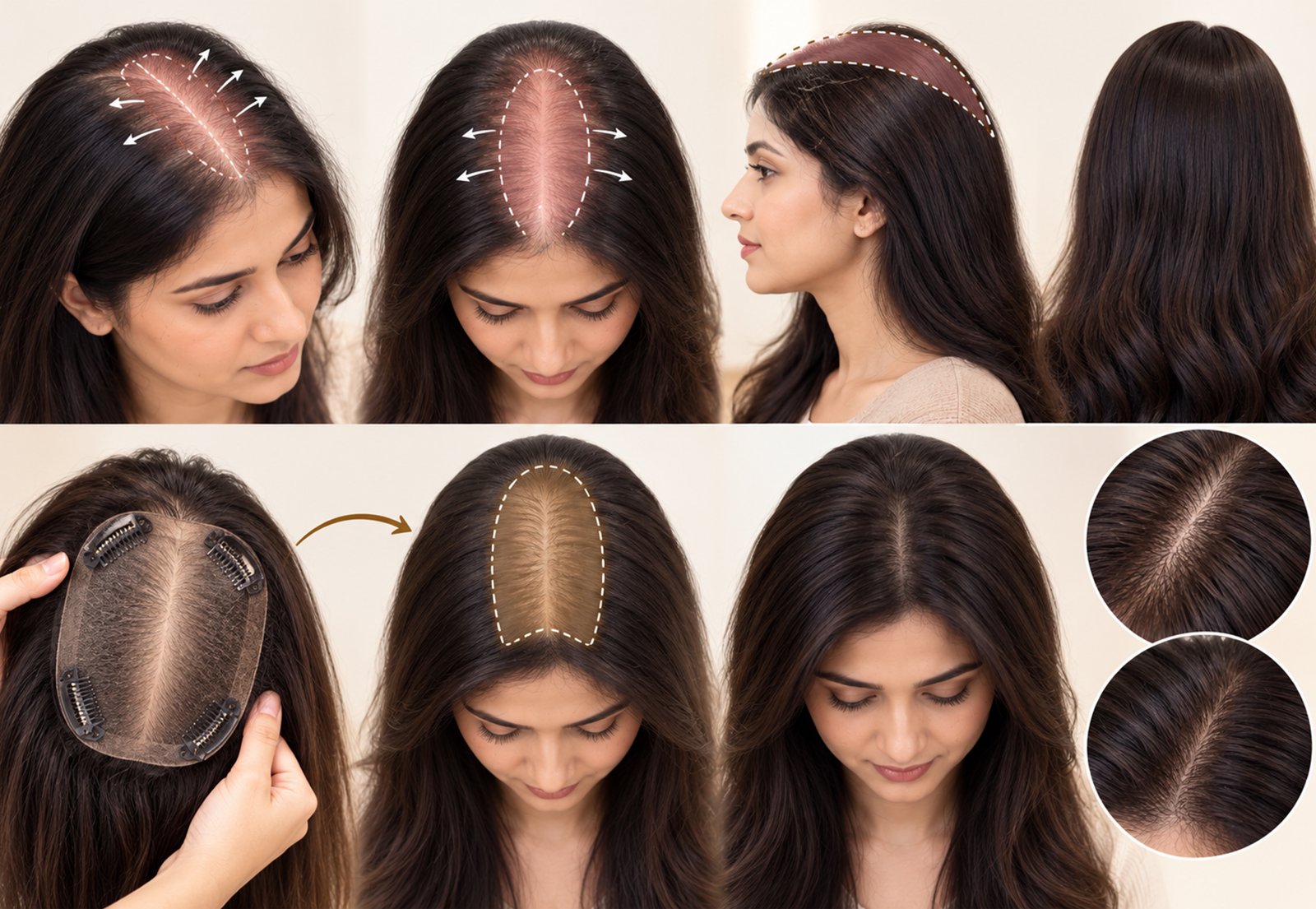
PCOS and PCOD cause hormonal imbalance, particularly increased androgen levels. These androgens cause hair follicles to gradually shrink over time, leading to thinner, weaker hair, especially around the crown and parting.
The mechanism is the same as male pattern baldness — both are driven by androgens acting on follicles with a genetic sensitivity to them. But in women, the pattern is different. Men typically lose hair in a defined receding pattern. Women with PCOD experience diffuse thinning — density reduces gradually across the top of the scalp, the parting widens, the crown becomes more visible, while the sides and back remain largely unaffected.
This creates a specific challenge: PCOS-related hair loss is frustrating because it is progressive and hormonal. As long as androgen levels remain elevated, the miniaturisation of hair follicles continues regardless of topical or nutritional treatment.
What this means in practice: even when PCOD is being managed medically — with metformin, oral contraceptives, or anti-androgen medications — hair regrowth is slow and partial. The follicles that have already miniaturised do not always recover. Medical treatment may prevent further loss, but it rarely restores the density that was lost.
This is the gap between what PCOD treatment achieves and what women experiencing visible thinning actually need.
The Treatments Women With PCOD Usually Try — and Their Honest Limitations
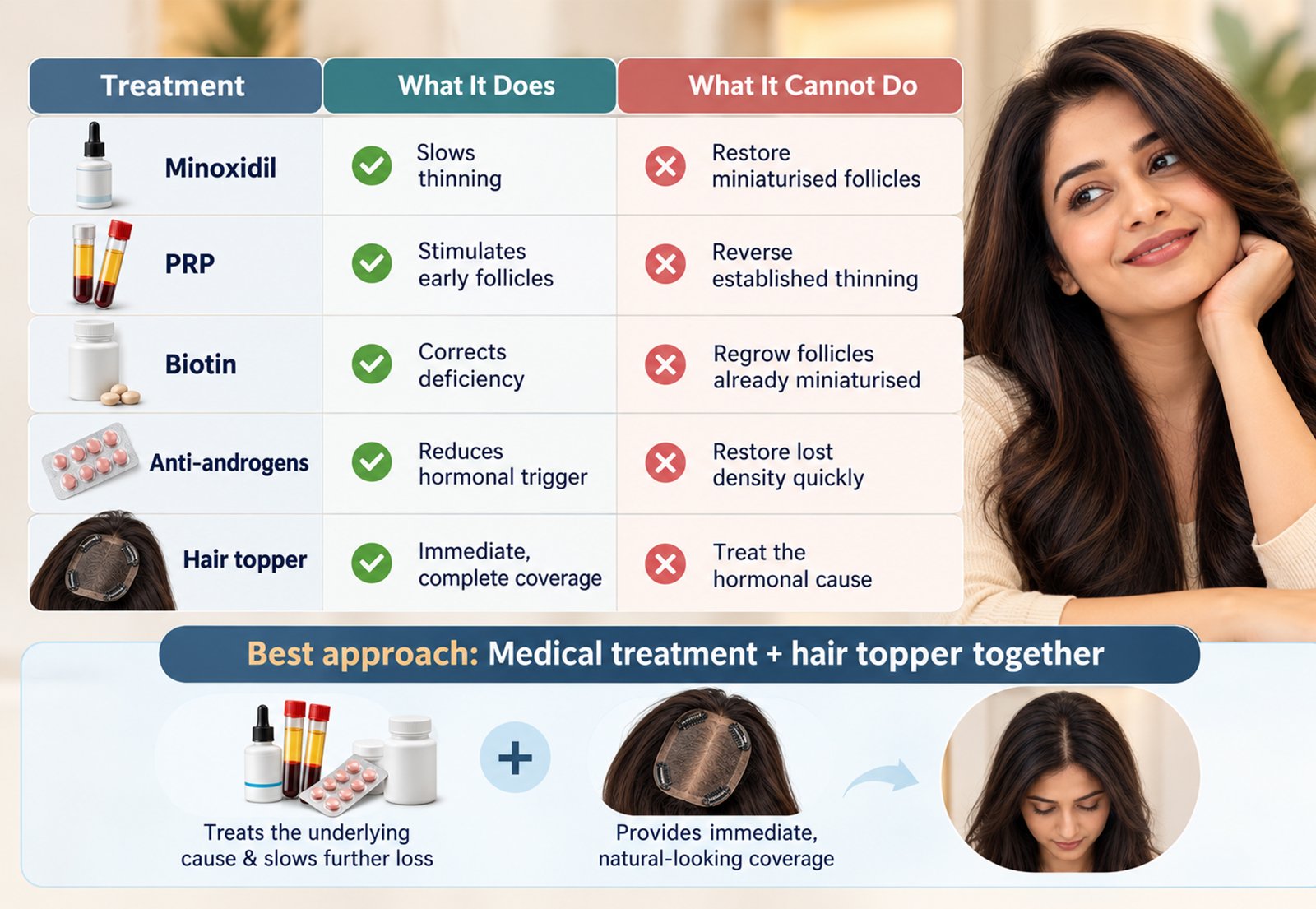
Minoxidil (topical)
The most commonly prescribed topical treatment for PCOD-related hair loss. Minoxidil prolongs the growth phase of hair follicles and increases blood flow to the scalp. It can slow thinning and, in some women, improve density modestly. However, it requires continuous use — stopping it often reverses any gains — and it does not address the underlying hormonal cause of follicle miniaturisation. Many women use it for years without the visible improvement they hoped for.
PRP (Platelet-Rich Plasma)
PRP involves injecting growth factors extracted from the patient’s own blood into the scalp to stimulate follicle activity. It has evidence for early-stage diffuse thinning, particularly when follicles are still present but dormant. However, PRP works best as a preventive or early-stage treatment. In women with established miniaturisation where follicles have already shrunk significantly, PRP results are modest and inconsistent. Multiple sessions are required, results vary widely, and the benefit diminishes for more advanced thinning.
Biotin and nutritional supplements
Biotin deficiency can cause hair loss — but most PCOD patients are not biotin-deficient. Supplementing biotin when levels are already normal produces no hair growth benefit. Iron, ferritin, vitamin D, and zinc deficiencies are more commonly relevant and worth checking — but correcting a deficiency prevents further loss; it does not restore miniaturised follicles.
Anti-androgen medications
Spironolactone, flutamide, or oral contraceptives with anti-androgenic properties can reduce the hormonal driver of hair loss. These are appropriate and sometimes effective — particularly in younger women caught early. But they require months to show any scalp effect, carry side effects, and are often not suitable for women trying to conceive.
The honest summary: PCOD hair loss treatments — all of them — work best at the early stage and for slowing progression. None of them reliably restore visible density in women who already have significant thinning at the crown and parting. This is not a failure of treatment; it is a biological reality about miniaturised follicles.
What Actually Provides Immediate, Visible Results
A non-surgical hair system — specifically a hair topper designed for the crown and parting area — provides immediate, complete coverage of PCOD-related thinning. Not a gradual improvement over months. Not a modest increase in density. On the day of fitting at Wig Boutique, you leave looking exactly as you want to look.
This is not a replacement for medical management of PCOD. It is a solution for the visible hair loss that medical management has not resolved — or has not yet resolved. Many of our clients continue their medical treatment alongside wearing a hair system — the two approaches work together, not in competition.
What a Hair Topper for PCOD Looks Like — Exactly
A hair topper is a partial hair system specifically designed for women with crown or parting area thinning. It sits at the top of the head, covers the thinning area precisely, and blends seamlessly with your existing hair at the sides and back.
PCOD-related hair loss affects the frontal and parietal regions — the crown and parting — while the sides and back remain largely unaffected. A hair topper designed for this specific pattern blends with the existing hair all around it.
What makes a PCOD topper different from a full wig?
A full wig covers the entire scalp — it is designed for women with total or near-total hair loss. A PCOD client typically still has good hair density at the sides and back. A topper works with that existing hair, not over it. The result looks more natural than a full wig because it is integrating with your own hair rather than replacing it.
What your topper is fitted to:
- Your exact thinning area — measured at the consultation, not estimated from a standard size
- Your natural hair colour — matched precisely, including any highlights, grey, or colour variation
- Your natural hair texture — straight, wavy, or slightly curly, matched so the topper blends naturally when your hair moves
- Your preferred parting direction — the topper is fitted so you can part your hair the same way you always have
- Your lifestyle — the attachment method (clips, tape, or integration) is matched to how active you are, how often you exercise, and how frequently you want studio visits
The PCOD Hair Loss Consultation at Wig Boutique — What to Expect
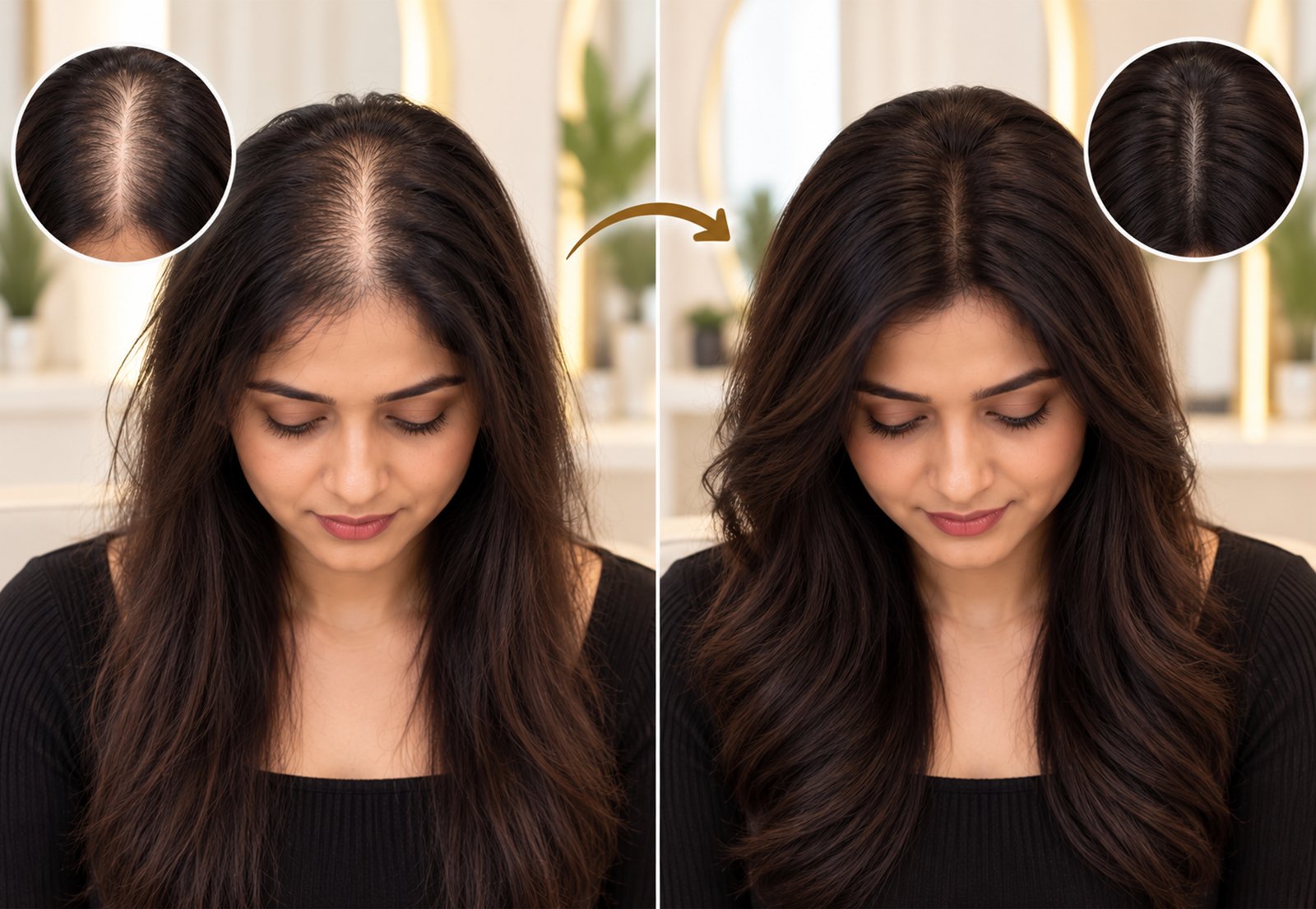
Every consultation for PCOD-related hair loss at Wig Boutique is conducted privately. This is not an open salon environment — you are in a private room with one of our experienced fitters.
Step 1: Hair loss assessment
We look at your specific thinning pattern — the extent of the parting widening, the crown density, whether the temples are affected, and where the remaining hair density is good. We ask about your PCOD treatment, your timeline of hair loss, and whether you have tried other solutions.
Step 2: Attachment method discussion
We discuss your lifestyle. If you exercise regularly, swim, or have an active daily routine — bonding or tape attachment is appropriate. If you prefer something you can remove daily — clip attachment is the right choice. We never apply the same method to every client.
Step 3: Hair matching
We match the topper to your natural hair colour, texture, and density. At Wig Boutique, every system is 100% human hair — ethically sourced, not synthetic. Human hair matches and blends precisely because it behaves exactly like your own hair. Synthetic systems cannot achieve this match with PCOD clients, whose remaining natural hair at the sides and back is often in excellent condition and very visible.
Step 4: Fitting
The topper is placed, adjusted, and blended by our fitter until the parting looks natural, the coverage is complete, and the transition between the topper and your natural hair is undetectable.
Step 5: Styling and home care instruction
We style the final result — you can see immediately what it looks like. We also walk you through the home care routine: how to wash, dry, and brush the system correctly at home to maintain the look between studio visits.
Frequently Asked Questions From Women With PCOD
Q: Will a hair topper work if I still have some hair at the crown?
Yes — in fact, some remaining hair at the crown makes the topper easier to blend and more natural in appearance. A hair topper is specifically designed to work with remaining hair, not to replace it entirely. The existing hair integrates with the topper’s hair for a completely natural transition.
Q: Can I colour the hair topper to match my natural hair colour?
Yes — all Wig Boutique systems are 100% human hair and can be coloured, toned, and highlighted exactly like natural hair. We match the colour at the consultation. If your natural hair colour changes — due to greying, colouring, or treatment — the topper can be adjusted to match at your next maintenance visit.
Q: Will the attachment damage my existing hair?
The attachment method is chosen to minimise impact on existing hair. For PCOD clients — whose remaining natural hair is often the foundation for the topper’s attachment — clip attachment is particularly gentle, as clips distribute weight evenly and are removed without adhesive. Tape and bonding methods are also available and do not damage the hair when applied and removed correctly by our team.
Q: Should I stop my PCOD treatment if I get a hair topper?
No — continue your medical management of PCOD as directed by your doctor. The hair topper addresses the visible thinning now; your medical treatment continues to address the hormonal cause. The two are completely compatible. Many of our clients wear a topper while their PCOD treatment gradually improves their underlying hair density.
Q: How natural does it actually look?
When properly matched and fitted by our experienced team, a PCOD hair topper is genuinely undetectable in everyday situations, in photographs, and in close personal interaction. The key factors are: 100% human hair, precise colour and texture matching, custom fitting to your specific parting and crown area, and correct blending of the topper with your existing hair. All of these are what Wig Boutique has been doing for 20 years.
A Note on Timing — Why Earlier Is Easier
The more hair that remains, the easier the topper fitting and the more natural the final result. A woman with moderate crown thinning and a widening parting gets a more seamlessly natural result than a woman who has waited until the thinning is extensive.
This is not a reason to panic — a hair topper works at every stage of PCOD-related thinning. But it is a reason not to wait. If you are currently at the stage where you are thinking, “I wish something could be done about this,” every time you look in the mirror — that is exactly the right time to book a consultation.
Book a Private Consultation at Wig Boutique, Rohini
If you have PCOD-related hair thinning and have found that medical treatments have not given you the visible result you needed — a private consultation at Wig Boutique is the next step.
Within one appointment, you will see exactly what a fitted topper looks like on your head, understand the maintenance commitment, and know what to expect going forward. There is no obligation at the consultation.
Wig Boutique is at Sector 8, Rohini — near Rohini East Metro Station Gate 2, opposite Metro Pillar No. 393. We serve women from across Rohini, Pitampura, Shalimar Bagh, Ashok Vihar, and Northwest Delhi.
📍 Landmark: Near Rohini East Metro Station | Opposite Metro Pillar No. 393
📞 Call / WhatsApp: +91 99996 76733
Hair patch for women — complete guide How to choose the best hair patch studio in Delhi Hair transplant vs hair patch — honest comparison Non-surgical hair replacement
Written by the Wig Boutique Expert Team — 20+ years of non-surgical hair replacement for women with PCOD, alopecia, postpartum hair loss and other causes, Rohini, Delhi. 5,000+ clients fitted. Last reviewed: October 2026.
Individual results vary. A private consultation assesses your specific hair loss pattern and determines the best-fit solution for your situation. Continue medical PCOD management as directed by your doctor.